Wild Wonders Forest Landmarks Trivia Sprint
Quiz Complete!
Wild Wonders of the World’s Forest Landmarks
Forests are more than collections of trees. They can be living museums, sacred corridors, and natural record books that hold clues to climate, culture, and time itself. Many of the world’s most memorable landmarks are found under a canopy, where mist softens the distance and the air smells like resin, leaf litter, or salt carried inland. Traveling through famous forests often feels like stepping into a different scale of life, especially in places where trees have been growing since before modern nations existed.
California’s coast redwoods are a classic example of nature at its most oversized. These trees are among the tallest organisms on Earth, thriving in a narrow band where fog frequently rolls in from the Pacific and supplies moisture even during dry months. Redwood groves can feel like outdoor cathedrals, with trunks wide enough to make people look miniature. Their survival story is also a cultural one: old growth stands were heavily logged in the nineteenth and early twentieth centuries, and the parks that protect them today reflect decades of conservation battles and shifting ideas about public land.
Not all forest landmarks are famous for size. Some are celebrated for oddity, like Poland’s Crooked Forest near the town of Gryfino, where hundreds of pines bend sharply near the base and then curve upward. The exact cause is still debated. Some theories point to human intervention, such as shaping trees for specialized timber, while others suggest unusual snow loads or local conditions. Whatever the origin, the grove has become a reminder that forests can carry mysteries alongside their beauty, and that human history often leaves subtle fingerprints on landscapes.
In Japan, forest paths are often inseparable from pilgrimage and tradition. Cedar-lined routes such as those associated with historic shrines and mountain worship are designed to slow the traveler down. Towering sugi cedars create a sense of continuity, and some individual trees are revered for their age and presence. These routes show how forests can be curated as cultural spaces without losing their wild character, and how a walk through the woods can also be a passage through centuries of belief, craft, and community.
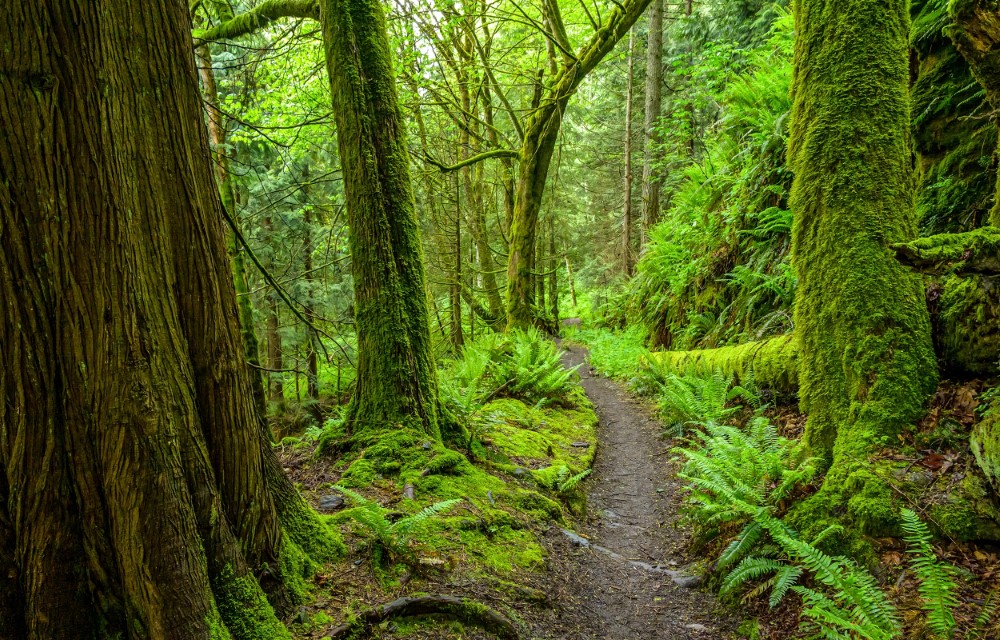
Across the Pacific Northwest, temperate rainforests add another layer to the story. Places like Olympic National Park in the United States and the Great Bear Rainforest region in Canada are defined by abundant rainfall, moss-draped branches, and dense understories where ferns and fungi thrive. Here, the landmarks are often ecosystems themselves: nurse logs that become gardens, salmon-bearing rivers that feed the forest through nutrients carried upstream, and coastal fog that moderates temperature. These forests also highlight the importance of Indigenous stewardship and modern protected-area design, where conservation is increasingly linked to cultural rights and long-term management.
UNESCO listings and other protections matter because forests are vulnerable to pressures that are easy to overlook on a short visit. Climate change shifts fire patterns, insect outbreaks, and drought stress. Tourism can bring funding and awareness, but also trail erosion, wildlife disturbance, and crowding at iconic viewpoints. The most rewarding forest travel tends to balance wonder with care: staying on paths, respecting closures, learning the local rules, and remembering that a landmark is not just a photo opportunity but a living system.
A good forest trivia sprint mirrors what makes these places unforgettable. Some answers are instantly recognizable, like the world’s tallest trees, while others are delightfully niche, like a grove of bent pines or a pilgrimage road framed by ancient cedar. Together they reveal a simple truth: the world’s legendary forests are not only scenic backdrops. They are archives of natural history and human meaning, still growing, still changing, and still capable of surprise.
-287005.jpg)