Brass, Gears, and Genius Steampunk Trivia

Quiz Complete!
Brass, Gears, and Genius: The Real Science Behind Steampunk Wonders
Steampunk feels like a world where every idea is powered by steam, polished in brass, and guided by fearless curiosity. What makes it so satisfying is that many of its most extravagant gadgets grow out of genuine nineteenth century science and engineering. The Victorian era was a time when machines became visible, noisy, and public. Factories, railways, and shipyards turned power into motion on a scale people could see, and that mechanical honesty is a big part of the steampunk look: exposed gears, riveted plates, pressure gauges, and hand valves that suggest a device you could repair with a wrench and patience.
Steam power sits at the heart of the aesthetic, and it was also a real revolution. Early steam engines were used to pump water from mines, but as designs improved, they became prime movers for mills, locomotives, and ships. A steam engine turns heat into work by expanding water into steam, pushing pistons or spinning turbines. The drama comes from the practical constraints: boilers must withstand pressure, fuel must be carried, and waste heat must be managed. Those limitations are why steampunk inventors obsess over clever condensers, compact boilers, and improbable efficiency tweaks. In reality, the biggest leaps came from better metallurgy, tighter machining, and improved thermodynamics, not just wilder imagination.
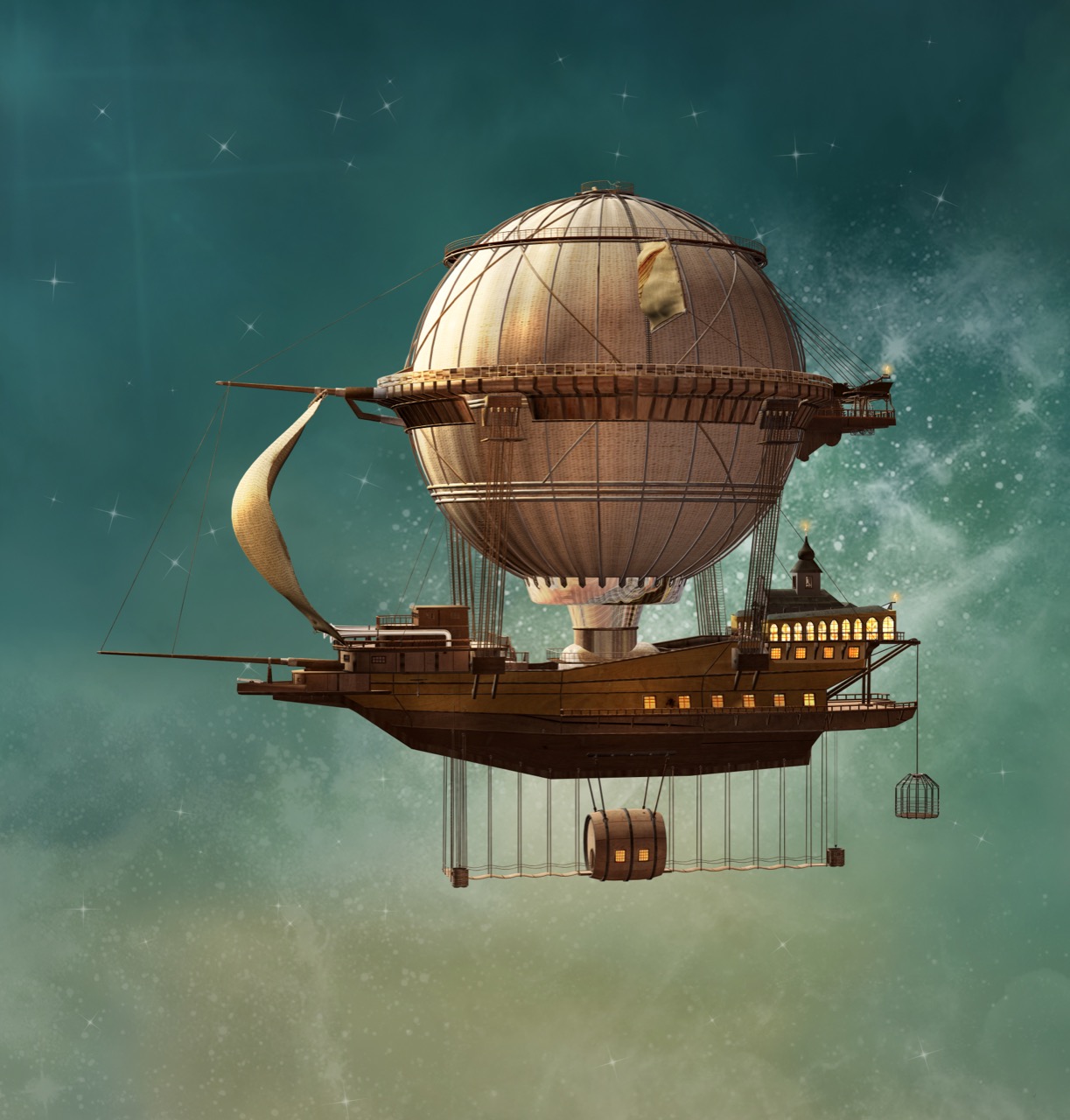
Airships are another signature element, and the vocabulary matters. A dirigible is any steerable lighter than air craft, while a zeppelin is a specific type of rigid airship developed by Count Ferdinand von Zeppelin, using an internal framework to hold its shape. Non rigid blimps keep their form mostly from gas pressure. Early airship designers fought constant battles with materials, weather, and lift. Hydrogen provides excellent buoyancy but is dangerously flammable, while helium is safer but historically scarce. Propulsion and steering were also tricky: even with engines, an airship is at the mercy of winds, which is why stories often feature elaborate navigation rooms and heroic pilots reading the sky.
Communication technology gives steampunk its sense of a connected world. The electric telegraph, widely adopted in the mid 1800s, transformed news, finance, and warfare by allowing messages to travel faster than any train. Morse code reduced language to pulses, and telegraph networks demanded standardized timekeeping. That need helped drive time zones and more accurate clocks, which in turn fit perfectly with steampunk’s fascination with precision instruments. Later, early telephones and radio experiments built on the same idea: turning human information into signals that could ride wires or waves.
Steampunk also loves thinking machines, and here the real history is wonderfully strange. Charles Babbage designed the Difference Engine and the Analytical Engine, mechanical devices intended to compute using gears and punched cards. Although his grandest machine was never completed in his lifetime, the concepts anticipated modern computing: a stored program, a “mill” for calculation, and memory. Ada Lovelace’s notes on the Analytical Engine described how such a machine could manipulate symbols, not just numbers, which is why she is often linked to early ideas of programming.
Automatons bring the era’s craftsmanship to life. A mechanical automaton is typically a self moving device driven by springs, weights, cams, and linkages, often repeating a set sequence like writing, playing music, or mimicking a bird. A modern robot, by contrast, usually senses its environment and can be reprogrammed, using electronics, motors, and software. Victorian makers produced astonishing clockwork figures, and even when steampunk stories exaggerate them into full companions or guardians, the charm comes from imagining how many gears, escapements, and carefully shaped cams it would take.
Materials and manufacturing are the quiet heroes behind all these wonders. Brass resists corrosion and machines well, making it ideal for fittings, instruments, and decorative panels. Iron and steel enabled stronger boilers, rails, and bridges, while rubber improved seals and insulation. The Industrial Revolution also advanced interchangeable parts and precision measurement, so devices could be assembled, repaired, and scaled up. When steampunk feels plausible, it is often because it respects these constraints: weight, friction, heat, and the stubborn realities of craftsmanship. The spectacle is real science wearing a theatrical coat, and the genius lies in knowing where history ends and imagination begins.